


Builders, Not Talkers: Why We Launched a Campaign Against the AI Grift
The Moment We Stopped Being Polite About It
There is a moment in every industry cycle when the grifters arrive. They show up right after the excitement peaks, just before the real work begins. They speak the language fluently. They have the certifications. They have the LinkedIn posts. They have the webinar schedule, the workshop deck, and the retainer structure. What they do not have is a single production system they have shipped.
We have been watching it happen in AI for two years now. And we are done being polite about it.
This is not a vague critique. This is an industry-wide problem with a measurable cost—measured in wasted budgets, stalled initiatives, burned trust, and companies that are now a full year behind because they paid someone to talk at them instead of build with them.
We launched a direct advertising campaign to say what everyone in serious AI circles has been thinking but nobody wants to say out loud: if they have not shipped it, they should not be teaching it.
The AI Grift Is Real and It Is Documented
This is not paranoia. This is pattern recognition.
The numbers tell the story. LinkedIn reported a 21-fold increase in members adding "AI" to their profiles in 2023 alone. Upwork saw a 1,000%+ surge in AI-related freelancer listings between 2022 and 2024. The FTC has issued multiple guidance documents and enforcement actions targeting companies that engaged in "AI-washing"—claiming AI capabilities that did not exist in their products. The UK Competition and Markets Authority launched a dedicated AI investigation unit in 2024 specifically because regulators could not keep pace with the volume of misleading claims in the space.
But the damage to individual businesses rarely makes headlines. It shows up as:
- $40,000 in strategy retainers that produced a 90-page PowerPoint and zero working code
- Six-month "AI readiness assessments" delivered just before the firm upsells you to a 12-month "implementation roadmap"
- AI fluency workshops sold by people who have never connected a model to a real database, owned an outage, or debugged a hallucination in a production system
- LinkedIn thought leaders with hundreds of thousands of followers who cannot answer a technical question in plain language because their entire content strategy is recycled press releases from OpenAI and Anthropic
The Federal Trade Commission put it plainly in 2023 guidance: "Keep AI claims in check. Before making claims about AI, make sure they're accurate and you have the evidence to back them up." The guidance was aimed at product companies, but the principle applies exactly as well to consultants.
Gartner's Hype Cycle for Artificial Intelligence has tracked this phenomenon for years. The pattern is consistent: a technology breakthrough creates a rush of vendor activity, most of it noise, followed by a "Trough of Disillusionment" when expectations meet reality. The organizations that survive and thrive are the ones who built relationships with practitioners—not presenters—before the trough arrived.
We are in the trough right now. And the grifters are still selling tickets to the peak.
What Bad AI Consulting Actually Looks Like
Let us be specific, because vagueness protects the wrong people.
Bad AI consulting has a recognizable shape. It starts with expensive positioning—thought leadership content, speaking slots, impressive-sounding credentials from institutions that have been running AI courses for eighteen months. Then comes the discovery phase: long, exploratory meetings that are positioned as relationship-building but are actually designed to delay the moment you ask for something tangible.
The proposal arrives. It is comprehensive. It includes phases, workstreams, governance models, change management frameworks, and a timeline measured in quarters. It does not include a working demo. It does not include a two-week deliverable. It does not include success metrics with actual numbers attached.
Then comes the onboarding period—often four to eight weeks—during which the team "gets up to speed" on your business. You pay for this. In full.
Months pass. Status reports arrive. They are full of activity metrics: meetings held, documents produced, workshops completed. They are thin on outcome metrics: problems solved, costs reduced, processes accelerated. When you ask for a demo, you get a slide deck with wireframes. When you ask about ROI, you get a response about "the long game."
By the time you realize the engagement is not working, you have spent six figures and have nothing to show for it except a slightly more sophisticated vocabulary about things that do not solve your actual problems.
We have talked to dozens of companies that went through exactly this sequence. The financial publishing company in our sixty-days-kickoff-to-roi case study had done what many organizations do—invested in an AI initiative on their own using popular no-code tools, got frustrated, and nearly wrote off AI entirely before finding a partner who could actually execute. They are not alone. They are the norm.
Why We Went Public With It
We did not launch this campaign to punch down at individuals. We launched it because silence was complicit.
Every week, we talk to businesses that have been burned. They are skeptical. They are behind schedule. They are trying to figure out whether AI is actually useful for their specific business or whether they just wasted a year chasing a trend. That skepticism is earned—but it is also dangerous, because it creates an excuse to delay decisions that are genuinely time-sensitive.
The opportunity cost of not moving in AI right now is real. The companies that are winning are not more "AI fluent." They are operational. They have agents running inside workflows. They have data wired into models. They have teams trained on real deployments, not workshop certificates.
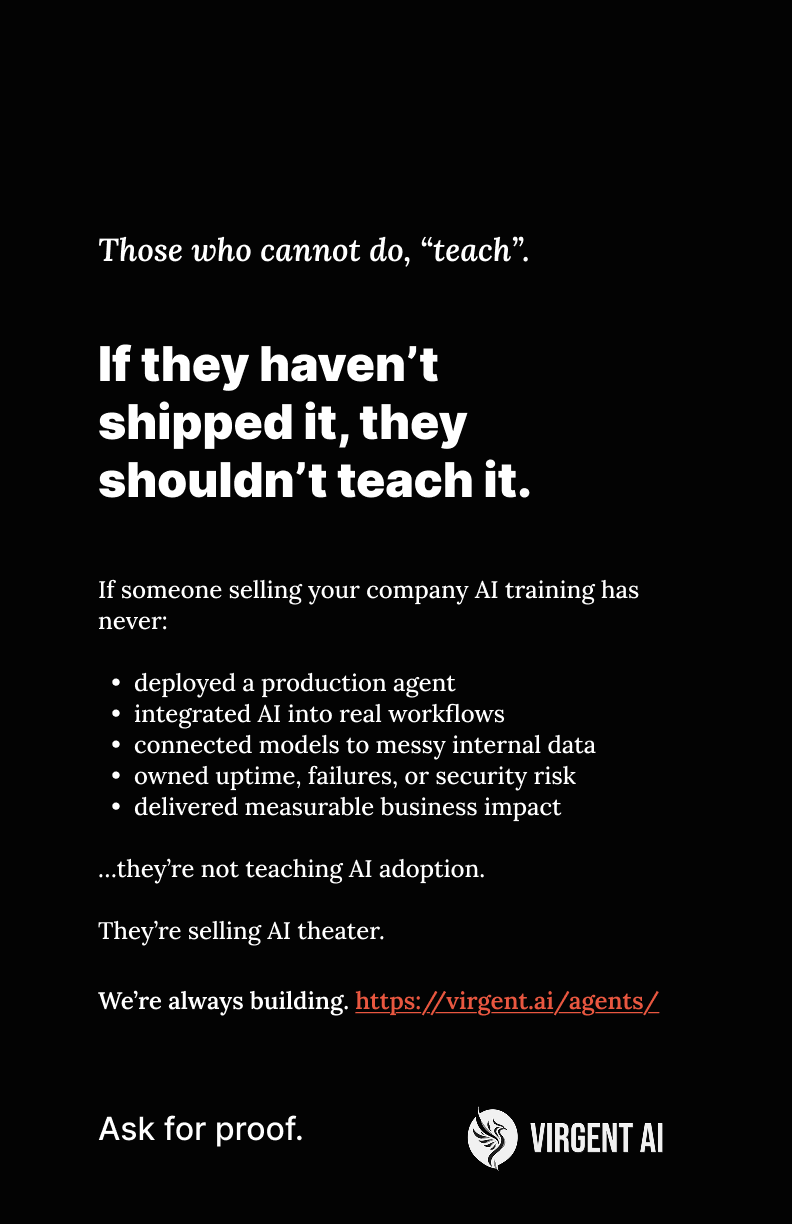
The first ad in our campaign is direct:
Those who cannot do, "teach." If they haven't shipped it, they shouldn't teach it. If someone selling your company AI training has never deployed a production agent, integrated AI into real workflows, connected models to messy internal data, owned uptime, failures, or security risk, or delivered measurable business impact—they are not teaching AI adoption. They are selling AI theater. Ask for proof.
We mean that literally. Ask your current AI consultant or vendor: what have you shipped? What is running in production right now? What were the failure modes and how did you fix them? What did it cost to operate, and what did it save? If they cannot answer those questions with specifics, you have the answer you need.
The Fastest-Growing AI Skill Is Not Vocabulary
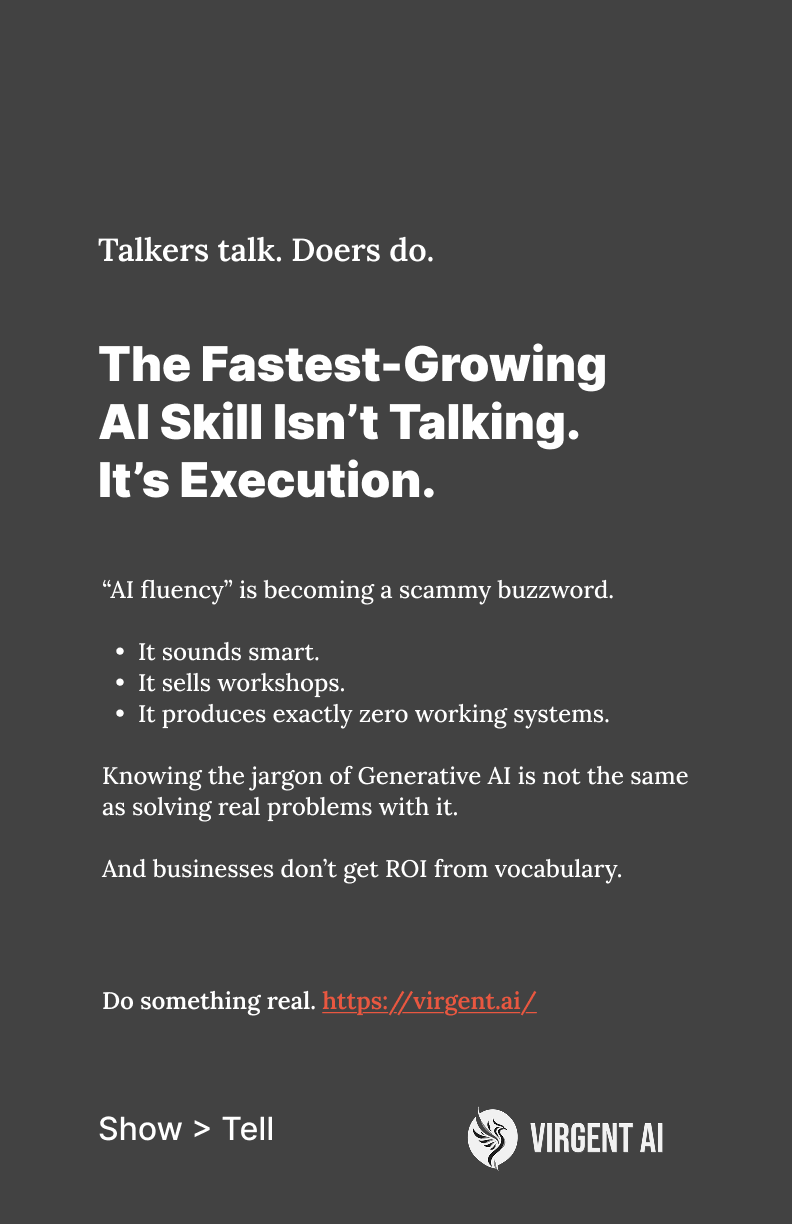
The second ad in the campaign is about execution—because that is the actual gap.
"AI fluency" has become a scammy buzzword. It sounds smart. It sells workshops. It produces exactly zero working systems. Knowing the jargon of Generative AI is not the same as solving real problems with it. And businesses do not get ROI from vocabulary.
We have seen the proof of this a hundred times in our own engagements. The organizations that move fastest are not the ones with the most sophisticated AI terminology—they are the ones with a clear problem, a willingness to make decisions quickly, and a partner accountable for outcomes rather than outputs.
The fastest-growing AI skill is not knowing what a RAG pipeline is. It is being able to build one, connect it to your actual data, handle the edge cases, and deploy something your customers or employees will use on day one.
That requires builders. Not talkers.
Companies Winning Right Now Are Operational
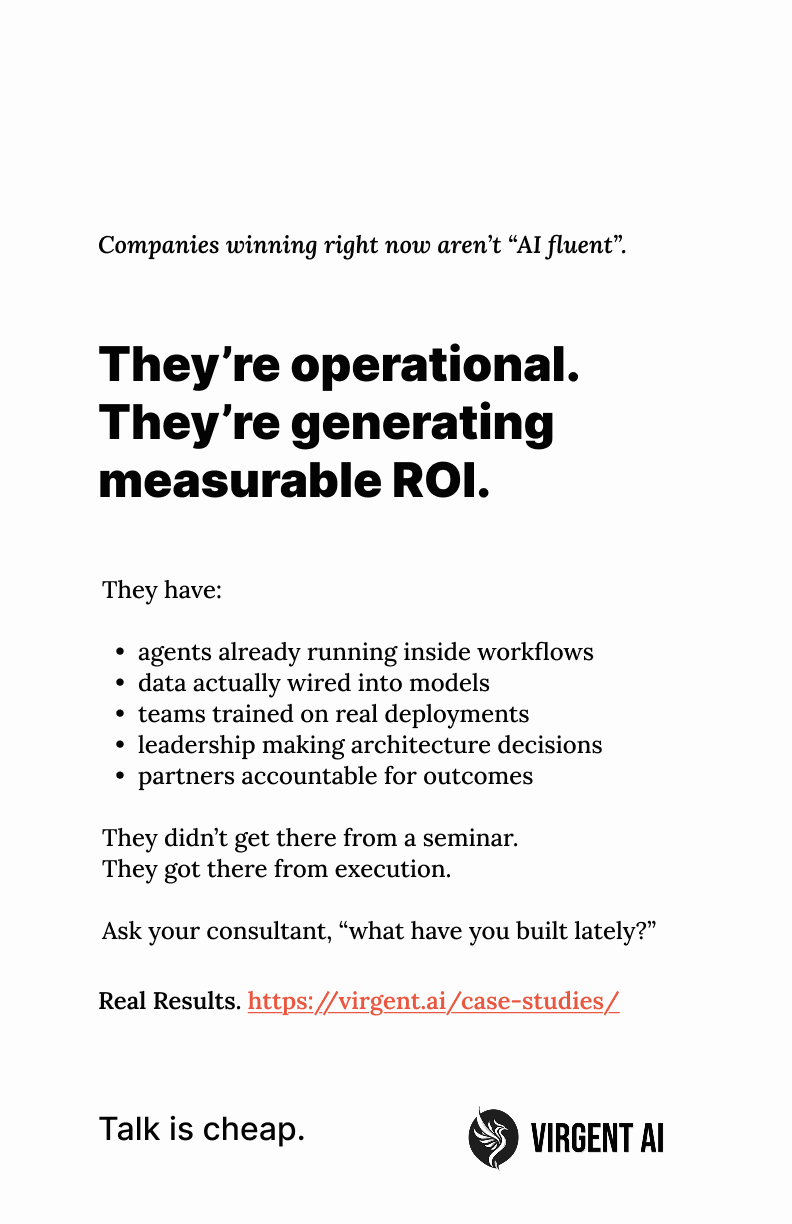
The third ad in the campaign names what is actually happening in the market.
Companies winning right now are not distinguished by their AI fluency scores. They are distinguished by what is already running. Agents inside workflows. Data wired into models. Teams making architecture decisions, not just attending briefings. Partners accountable for outcomes—not partners who disappear behind an "onboarding period."
They did not get there from a seminar. They got there from execution.
The question to ask your consultant is not "do you understand AI?" The question is: what have you built lately?
We have a public answer to that question at virgent.ai/case-studies. Production systems. Real integrations. Measurable savings. And we add to it every sprint cycle—because we are always building.
What Real AI Partnership Looks Like: The Strong Start
We developed the Strong Start process because we believe the first engagement should generate value, not just set expectations.
Most AI consulting engagements front-load the cost and back-load the value. You spend weeks being sold to, assessed, onboarded, and planned at—before anyone builds anything. We inverted that structure entirely.
The Strong Start has two components, and both happen in the first engagement. No "getting up to speed" period. No onboarding tax. We hit the ground running on day one.
Part One: Asking AI To Do Things With Our Data
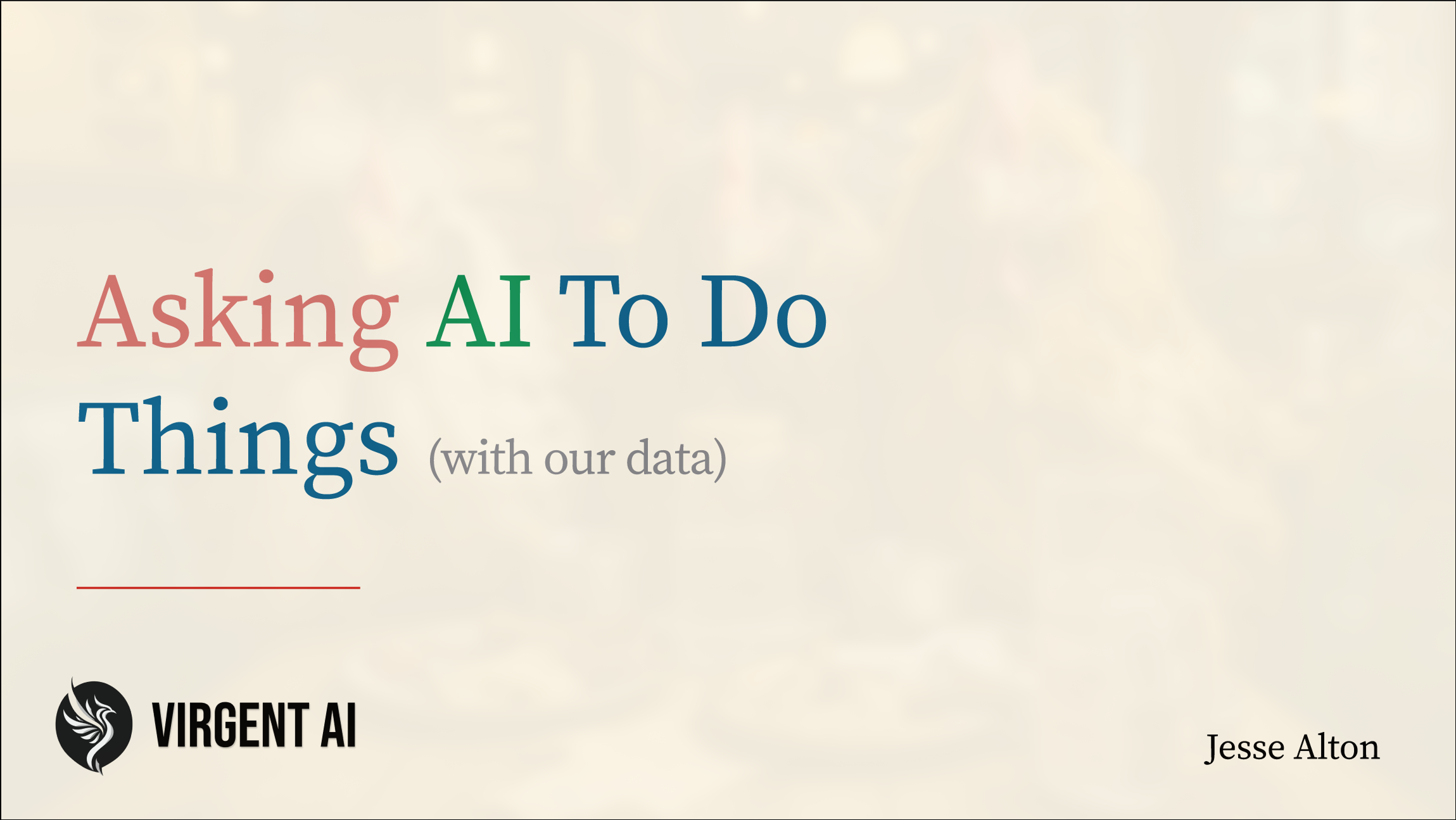
The first component is a shared language session we call Asking AI To Do Things With Our Data. Not because the terminology is complicated—but because the terminology gets weaponized constantly, and we refuse to let that happen in our engagements.
We break down the entire conceptual landscape of AI into four words that map to four real disciplines:
- We Ask — prompt engineering: how we communicate with AI systems, what makes a good instruction versus a bad one, and how framing affects outcomes
- AI — the models themselves: which ones exist, what they are good at, what they cost, and why model selection matters
- To Do Things — product thinking: how we identify problems worth solving, how we define success, and how we avoid building solutions to non-problems
- With Our Data — data readiness: where your data lives, what state it is in, and what has to be true before a model can use it usefully
This is not a lecture. It is a calibration. The goal is a shared vocabulary so that when we talk about "context windows" or "embeddings" or "intent recognition," we are all speaking the same language with the same understanding. Thirty minutes, shared baseline, no condescension.
This is what separates a real kickoff from an expensive info session. We do not charge separately for education. It is part of the work.
Part Two: The Lightning Decision Jam
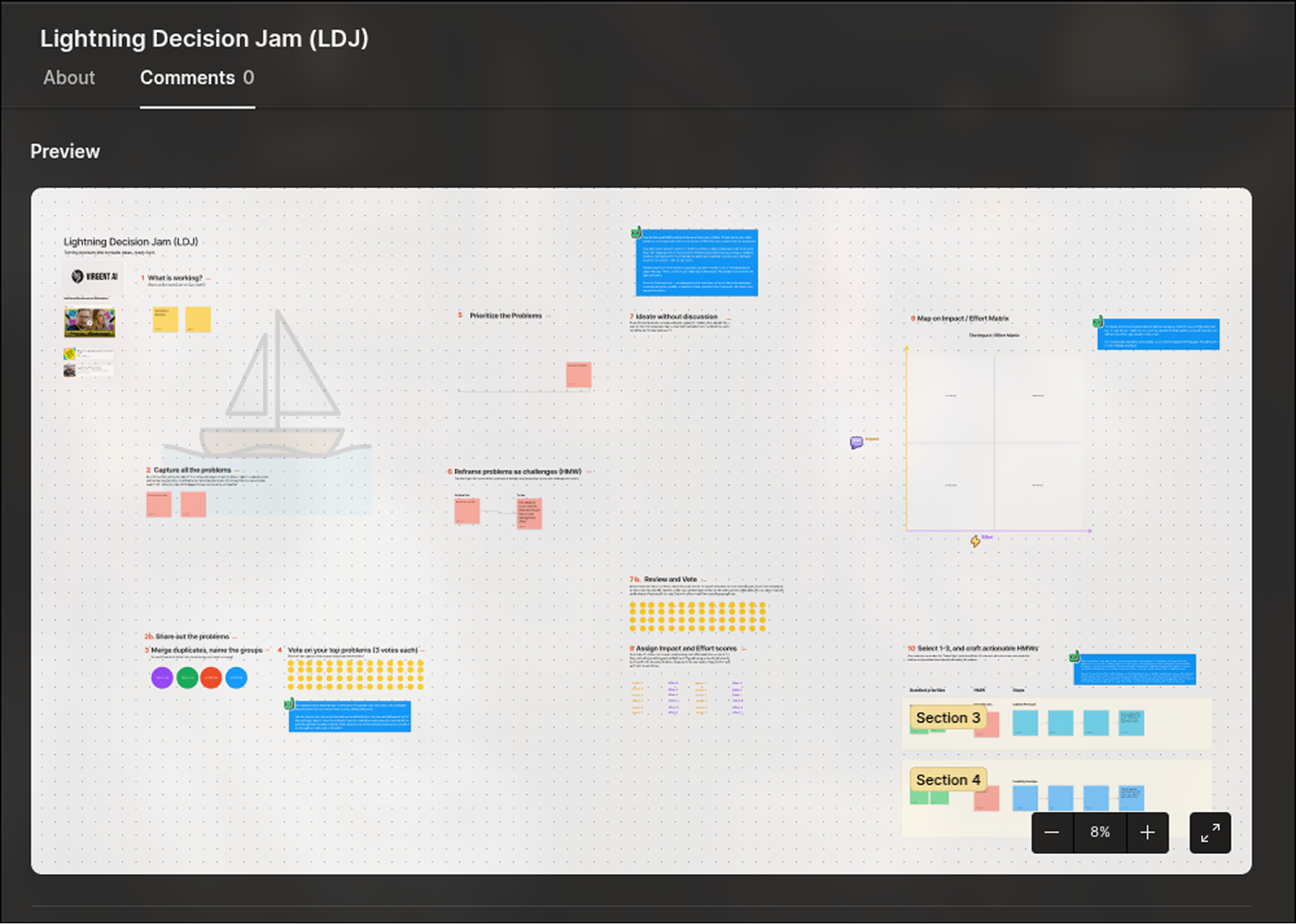
The second component is our first Lightning Decision Jam (LDJ)—a structured, repeatable facilitation framework that turns your team's scattered pain points into a prioritized, actionable backlog with measurable sprint zero defined before you leave the room.
Here is what the LDJ actually does, in order:
- What is working? We start with wins. Not to be positive for its own sake, but because knowing what is working constrains the solution space and tells us what to protect.
- Capture all the problems. Everyone dumps every frustration, bottleneck, and broken process onto the board. Individually and silently—no groupthink, no loudest voice in the room winning.
- Share out, merge duplicates, name the groups. We cluster related problems and give them plain language names. No jargon. If it takes three sentences to explain, it needs a simpler label.
- Vote on your top problems. Three votes each. Democratic. Fast. Real signal on what the room actually cares about.
- Prioritize the problems. Combine the vote results with a quick effort/impact read to surface the clear top candidates.
- Reframe problems as challenges (HMW). We convert each priority into a "How Might We" question—a small linguistic shift that turns a complaint into a design brief.
- Ideate without discussion. Solutions generated individually before group pressure shapes them.
- Assign Impact and Effort scores. Every solution gets a honest two-axis assessment. High impact, low effort items rise to the top automatically.
- Map on Impact/Effort matrix. Visual clarity on what to tackle first.
- Select 1-3 and craft actionable HMWs. Leave the session with a defined sprint zero: one problem, one measurable two-week deliverable, one clear definition of done.
The entire session takes two to three hours. You leave with a backlog—a real one, not a theoretical one—and a sprint that starts the next day.
That is the Virgent AI way. We do not wait to get started. We start before the meeting is over.
Two Weeks. Demo Day. Repeat.
Everything we do is organized around two-week sprints with demo days.
This is not a methodology choice. It is an accountability structure. Every two weeks, we show you working software—not slides, not reports, not "progress updates." Working software that does something real and measurable.
The demo is not a presentation of what we are going to build. It is a demonstration of what we built. This week. This sprint.
This creates a forcing function for prioritization. If something is in sprint, it gets finished. If it does not get finished, we know it immediately—not six months from now. The feedback loop is two weeks, not two quarters. Corrections are cheap. Mistakes are recoverable. Stakeholders stay engaged because there is always something new to react to.
Our clients find measurable ROI in the first two to four weeks—not because we overpromise, but because the LDJ process surfaces the highest-leverage problems first and we build directly against those problems. By the time the first demo day arrives, we have often already replaced something that was costing money every day.
You used to have to pick between good, fast, and cheap. You had to compromise on at least one. Not anymore. A focused, well-structured AI engagement can be all three—if the partner you choose has actually shipped what they are selling you.
What You Get With Virgent
A manageable retainer. No per-talent overhead. No bloated team of people "ramping up" at your expense. A fluid, rolling relationship built on trust, open dialog, and real measurable results—in language you can actually follow and verify.
We start small if that is what you need. We scale fast if you are ready for it—up to 100+ people within 30 days through our network. For startups and early-stage organizations, we work with funding organizations like TEDCO and Maryland Tech Council that can help offset the cost of technology transformation.
But here is what matters most: we are always building. Not always talking about building. Not always planning to build. Actually building. Right now.
If you want to see proof, it is at virgent.ai/case-studies.
If you want a partner who has shipped what they are selling—who can tell you the failure modes, the edge cases, the real costs and real savings, the mistakes made and recovered from—that is what we offer.
The first conversation is always free. The quote is good for a year. We have no interest in pressuring a timeline.
What we do insist on: that if we engage, we deliver something real in the first two weeks. That is not a marketing claim. That is the contractual baseline. If we do not show you working software at the two-week demo day, we have not done our job.
For Organizations Trying to Figure Out Who to Trust
The AI consulting market is a credibility desert right now. The signal-to-noise ratio is catastrophic. And the cost of picking the wrong partner is not just financial—it is the opportunity cost of the months you lost, the internal skepticism you have to overcome, and the organizational fatigue that makes the next AI initiative harder to get funded.
Here is a simple rubric for evaluating any AI partner, including us:
Ask to see what they have shipped. Not what they have designed. Not what they have planned. Not what their clients have achieved in vague percentage terms without context. Ask for specific systems in production, with specific problems they solved, with specific numbers on cost and impact.
Ask who on their team has owned an outage. Anyone who has deployed production AI has had something break in an unexpected way. Hallucinations at scale. Rate limit failures under load. Vector database corruption. Prompt injection attempts. If your prospective partner has clean hands, they have not been in the arena.
Ask what their smallest engagement looks like. Legitimate builders can start small. Grifters need large retainers to justify the theater. If the minimum engagement is a six-month commitment before anything gets delivered, run.
Ask to see the demo before you sign. We have a live agent sandbox at virgent.ai/agents. Our case studies show real systems with real architecture and real results. We show before we tell. Every time.
The AI grifters are betting that you do not know the right questions to ask. Now you do.
Virgent AI is a builder-first AI consulting and development firm. We ship production software in two-week increments, measure everything, and tell you the truth. The first call is free. The quote lasts a year. And we will show you what we have built before we ask you to trust us with what you need to build.
Book a call or reach us at hello@virgent.ai.
